HYBRID CAR
HOW A HYBRID CAR WORK
A hybrid vehicle uses two or more distinct types of power,
such as internal combustion engine to drive an electric generator that powers
an electric motor. E.g. in diesel-electric trains using diesel engines to drive
an electric generator that powers an electric motor, and submarines that use
diesels when surfaced and batteries when submerged. Other means to store energy
include pressurized fluid in hydraulic hybrids.This is the main fact of a hybrid car.
The basic principle with hybrid vehicles is that the
different power sources work better at different speeds and then switching from
one to the other at the proper time during the speed transform yields a win-win
in terms of energy efficiency, as such that translates into greater fuel
efficiency,
For example: Power, two wheel and cycle type vehicle, heavy
vehicle etc.
Hybrid systems are coming into use for trucks, buses and
other heavy highway vehicles. Small fleet sizes and installation costs are
compensated by fuel savings, [needs update] with advances such as higher
capacity, lowered battery cost etc. Toyota, Ford, GM and others are introducing
hybrid pickups and SUVs. Ken worth Truck Company recently introduced the Ken
worth T270 Class 6 that for city usage seems to be competitive. FedEx and
others are investing in hybrid delivery vehicles — particularly for city use
where hybrid technology may pay off first. As of December 2013 FedEx is trialing
two delivery trucks with Wright speed electric motors and diesel generators;
the retrofit kits are claimed to pay for themselves in a few years. The diesel
engines run at a constant RPM for peak efficiency.
In 1978 students at Minneapolis, Minnesota's Hennepin
Vocational Technical Center, converted a Volkswagen Beetle to a petro-hydraulic
hybrid with off-the shelf components. A car rated at 32 mpg was returning 75
mpg with the 60 hp engine replaced by a 16 hp engine, and reached 70 mph. In
the 1990s, engineers at EPA’s National Vehicle and Fuel Emissions Laboratory
developed a petro-hydraulic power train for a typical American sedan car. The
test car achieved over 80 mpg on combined EPA city/highway driving cycles.
Acceleration was 0-60 mph in 8 seconds, using a 1.9 liter diesel engine. No lightweight
materials were used. The EPA estimated that produced in high volumes the
hydraulic components would add only $700 to the cost.[21] Under EPA testing, a
hydraulic hybrid Ford Expedition returned 32 mpg (7.4 L/100 km) City, and 22
mpg (11 L/100 km) highway. UPS currently has two trucks in service using this
technology
In a series hybrid bicycle (SHB) (a kind of chainless
bicycle) the user pedals a generator, charging a battery or feeding the motor,
which delivers all of the torque required. They are commercially available,
being simple in theory and manufacturing.
The first published prototype of an SHB is by Augustus
Kinzel (US Patent 3'884'317) in 1975. In 1994 Bernie Macdonalds conceived the Electrolyte
SHB with power electronics allowing
regenerative braking and pedaling while stationary. In 1995 Thomas Muller
designed and built a "Fahrrad mit elektromagnetischem Antrieb" for
his 1995 diploma thesis. In 1996 Jürg Blatter and Andreas Fuchs of Berne
University of Applied Sciences built an SHB and in 1998 modified a Leitra
tricycle (European patent EP 1165188). Until 2005 they built several prototype
SH tricycles and quadricycles.[5] In 1999 Harald Kutzke described an
"active bicycle": the aim is to approach the ideal bicycle weighing
nothing and having no drag by electronic compensation.
A series hybrid electric-petroleum bicycle (SHEPB) is
powered by pedals, batteries, a petrol generator, or plug-in charger -
providing flexibility and range enhancements over electric-only bicycles.
A SHEPB prototype made by David Kitson in Australia in 2014
used a lightweight brushless DC electric motor from an aerial drone and small
hand-tool sized internal combustion engine, and a 3D printed drive system and
lightweight housing, altogether weighing less than 4.5 kg. Active cooling keeps
plastic parts from softening. The prototype uses a regular electric bicycle
charge port.
Heavy
vehicle
Bus Rapid Transit of Metz, a diesel-electric hybrid driving
system by Van Hool
Hybrid power trains use diesel-electric or turbo-electric to
power railway locomotives, buses, heavy goods vehicles, mobile hydraulic
machinery, and ships. A diesel/turbine engine drives an electric generator or
hydraulic pump, which powers electric/hydraulic motor(s) - strictly an
electric/hydraulic transmission (not a hybrid), unless it can accept power from
outside. With large vehicles conversion losses decrease, and the advantages in
distributing power through wires or pipes rather than mechanical elements
become more prominent, especially when powering multiple drives — e.g. driven
wheels or propellers.
Until recently most
heavy vehicles had little secondary energy storage, e.g. batteries/hydraulic
accumulators — excepting non-nuclear submarines, one of the oldest production
hybrids, running on diesels while surfaced and batteries when submerged. Both
series and parallel setups were used in WW2 submarines.
When the term hybrid vehicle is used, it most often refers
to a Hybrid electric vehicle. These encompass such vehicles as the Saturn Vue,
Toyota Prius, Toyota Yaris, Toyota Camry Hybrid, Ford Escape Hybrid, Toyota
Highlander Hybrid, Honda Insight, Honda Civic Hybrid, Lexus RX 400h and 450h,
Hyundai Ioniq and others. A petroleum-electric hybrid most commonly uses
internal combustion engines (using a variety of fuels, generally gasoline or
Diesel engines) and electric motors to power the vehicle. The energy is stored
in the fuel of the internal combustion engine and an electric battery set.
There are many types of petroleum-electric hybrid drivetrains, from Full hybrid
to Mild hybrid, which offer varying advantages and disadvantages.[28]
William H. Patton filed a patent application for a
gasoline-electric hybrid rail-car propulsion system in early 1889, and for a
similar hybrid boat propulsion system in mid 1889.[29][30] There is no evidence
that his hybrid boat met with any success, but he built a prototype hybrid tram
and sold a small hybrid locomotive.[31][32]
In 1899, Henri Pieper developed the world's first
petro-electric hybrid automobile. In 1900, Ferdinand Porsche developed a
series-hybrid using two motor-in-wheel-hub arrangements with an internal
combustion generator set providing the electric power; Porsche's hybrid set two
speed records.[citation needed] While liquid fuel/electric hybrids date back to
the late 19th century, the braking regenerative hybrid was invented by David Arthurs,
an electrical engineer from Springdale, Arkansas in 1978–79. His home-converted
Opel GT was reported to return as much as 75 mpg with plans still sold to this
original design, and the "Mother Earth News" modified version on
their website.[33]
The plug-in-electric-vehicle (PEV) is becoming more and more
common. It has the range needed in locations where there are wide gaps with no
services. The batteries can be plugged into house (mains) electricity for
charging, as well being charged while the engine is running
Parallel
hybrid
Honda Insight, Mild Parallel Hybrid

Toyota Prius, series-parallel hybrid

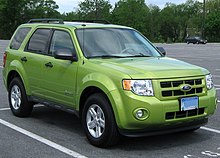
Ford Escape Hybrid, a series-parallel drive train
In a parallel hybrid vehicle an electric motor and an
internal combustion engine are coupled such that they can power the vehicle
either individually or together. Most commonly the internal combustion engine,
the electric motor and gear box are coupled by automatically controlled
clutches. For electric driving the clutch between the internal combustion engine
is open while the clutch to the gear box is engaged. While in combustion mode
the engine and motor run at the same speed.
The first mass production parallel hybrid sold outside Japan
was the 1st generation
Mild parallel hybrid
These types use a generally compact electric motor (usually
<20 kW) to provide auto-stop/start features and to provide extra power assist
during the acceleration, and to generate on the deceleration phase (aka
regenerative braking).
On-road examples include Honda Civic Hybrid, Honda Insight
2nd generation, Honda CR-Z, Honda Accord Hybrid, Mercedes Benz S400 Blue HYBRID,
BMW 7 Series hybrids, General Motors BAS Hybrids, Suzuki S-Cross, Suzuki Wagon
R and Smart for two with micro hybrid drive.
মন্তব্যসমূহ
একটি মন্তব্য পোস্ট করুন